A $41,200 humanoid robot was unveiled in China

The Chinese company UBTech Robotics presented a humanoid robot for 299,000 yuan ($41,200). This is reported by SCMP.

Tien Kung Xingzhe was developed in collaboration with the Beijing Humanoid Robot Innovation Center. It is available for pre-order, with deliveries expected in the second quarter.

The robot is 1.7 meters tall and can move at speeds of up to 10 km/h. Tien Kung Xingzhe easily adapts to a variety of surfaces, from slopes and stairs to sand and snow, maintaining smooth movements and ensuring stability in the event of collisions and external interference.

The robot is designed for research tasks that require increased strength and stability. It is powered by the new Huisi Kaiwu system from X-Humanoid. The center was founded in 2023 by UBTech and several organizations, including Xiaomi. He develops products and applications for humanoids.

UBTech’s device is a step towards making humanoid robots cheaper, SCMP notes. Unitree Robotics previously attracted public attention by offering a 1.8-meter version of the H1 for 650,000 yuan ($89,500). These robots performed folk dances during the Lunar New Year broadcast on China Central Television in January.

EngineAI’s PM01 model sells for 88,000 yuan ($12,000), but it is 1.38 meters tall. Another bipedal version, the SA01, sells for $5,400, but without the upper body.

In June 2024, Elon Musk said that Optimus humanoid robots will bring Tesla’s market capitalization to $25 trillion.
Alibaba Upgrades Quark Into a Next-Gen AI Assistant

As stated by Bloomberg, Quark’s app has undergone an update that incorporates the latest Qwen neural network, enhancing its functionalities. Quark was first introduced in 2016 as a web browser, but now it has undergone a transformation into an AI assistant that integrates sophisticated chatbot-like conversational skills and independent reasoning and task completion into one easy-to-use application.

The “new Quark” is designed to be a versatile tool, capable of tackling a wide range of tasks with remarkable efficiency. From generating high-quality images and drafting detailed articles to planning personalized travel itineraries and creating concise meeting minutes, Quark is poised to become an indispensable companion for its users. This transformation reflects Alibaba’s ambition to integrate artificial intelligence more deeply into everyday life, offering a glimpse into the future of smart, intuitive technology.

Wu Jia, CEO of Quark and Vice President of Alibaba, emphasized the app’s potential to unlock new horizons for its users. “As our model continues to evolve, we see Quark as a gateway to boundless opportunities,” Wu stated. “With the power of artificial intelligence, users can explore and accomplish virtually anything they set their minds to.

Quark’s journey began nearly a decade ago as a simple web browser, but it has since grown into a powerhouse with a reported user base of 200 million people across China. This impressive milestone underscores Alibaba’s ability to scale and adapt its offerings to meet the demands of a rapidly changing digital landscape.

The revamped Quark builds on Alibaba’s recent advancements in AI technology, including the introduction of the QwQ-32 model in March 2025, a reasoning-focused AI designed to enhance problem-solving and decision-making capabilities. By integrating the Qwen neural network, Quark now stands at the forefront of Alibaba’s AI ecosystem, blending innovation with practicality to cater to both individual and professional needs.

This strategic overhaul positions Quark as more than just an app—it’s a visionary tool that could redefine how users interact with technology, solidifying Alibaba’s role as a global leader in AI-driven solutions. As the company continues to refine its models, Quark promises to deliver an ever-expanding array of features, making it a dynamic platform for creativity, productivity, and exploration.

Elon Musk Blames ‘Massive Cyber-Attack’ for X Outages, Alleges Ukrainian Involvement

Elon Musk has claimed that a “massive cyber-attack” was responsible for widespread outages on X, the social media platform formerly known as Twitter. The billionaire suggested that the attack may have been orchestrated by a well-resourced group or even a nation-state, potentially originating from Ukraine.

X Faces Hours of Service Disruptions
Throughout Monday, X experienced intermittent service disruptions, preventing users from loading posts. Downdetector, a service that tracks online outages, recorded thousands of reports, with an initial surge around 5:45 AM, followed by a brief recovery before another wave of disruptions later in the day. The majority of issues were reported on the platform’s mobile app.

Users attempting to load tweets were met with an error message reading, “Something went wrong,” prompting them to reload the page.

Musk addressed the situation in a post on X, stating:

We get attacked every day, but this was done with a lot of resources. Either a large, coordinated group and/or a country is involved.”

However, Musk did not provide concrete evidence to support his claims.

Musk Suggests Ukrainian Involvement
Later in the day, during an interview with Fox Business, Musk doubled down on his allegations, suggesting that the attack may have originated from Ukraine.

We’re not sure exactly what happened, but there was a massive cyber-attack to try and bring down the X system with IP addresses originating in the Ukraine area,” Musk stated.

The claim comes amid Musk’s increasingly strained relationship with the Ukrainian government. Over the weekend, he asserted that Ukraine’s “entire front line” would collapse without access to his Starlink satellite communication service. Additionally, he criticized U.S. Senator Mark Kelly, a supporter of continued aid to Ukraine, labelling him a “traitor.”

A Pattern of Unverified Cyber-Attack Claims
Musk has previously attributed X outages to cyber-attacks. When his live-streamed interview with Donald Trump crashed last year, he initially claimed it was due to a “massive DDoS attack.” However, a source later told The Verge that no such attack had occurred.

Broader Challenges for Musk’s Businesses
The disruptions at X add to a series of recent setbacks for Musk’s ventures.

SpaceX Mishap: On Friday, a SpaceX rocket exploded mid-flight, scattering debris near the Bahamas.
Tesla Under Pressure: A growing “Tesla takedown” movement has led to protests at dealerships, while Tesla’s stock price continues to slide, hitting its lowest point in months.
Political Tensions: Musk’s meeting with Donald Trump last week reportedly grew tense, with Trump hinting at curbing the billionaire’s influence over government agencies.

The Bottom Line
While Musk attributes X’s outages to a large-scale cyber-attack, no independent evidence has surfaced to confirm this claim. Given his history of making similar allegations without substantiation, the true cause of the disruption remains unclear. Meanwhile, mounting challenges across Musk’s business empire suggest that cyber-attacks may not be the only crisis he is facing.

Meta Develops Specialised AI Chip

Meta is testing its own chip for training AI systems, Reuters reports, citing sources.

According to the agency, the new processor is a specialized accelerator aimed at solving specific problems for artificial intelligence. This approach makes the chip more energy efficient compared to integrated graphics processors traditionally used for AI workloads.

The company is collaborating with Taiwan’s TSMC. At the moment, the initial stage of development has been completed, which includes creating and sending prototypes to the chip factory for testing.

Developing its own processors is part of Meta’s plan to reduce infrastructure costs. It is betting on artificial intelligence to ensure growth.

The corporation predicts spending in 2025 in the amount of $114-119 billion, of which $65 billion will be directed to the artificial intelligence sector.

Meta wants to start using its own chips for AI tasks in 2026, Reuters writes.

In May 2023, the company introduced two specialised processors for artificial intelligence and video processing tasks.

Earlier, the media learned about OpenAI working on its own AI processor in partnership with Broadcom and TSMC.

The Chinese company ByteDance is developing a similar product in collaboration with Broadcom.

Event-Driven Architectures for AI Applications: Patterns & Use Cases

The landscape around Artificial Intelligence (AI) is always changing, which increases the demand for flexible, scalable, and real-time systems. During the development of AI applications, the Event Driven Architecture (EDA) approach enables flexible responsiveness to optimisation needs at a structural level. This note accompanying ExploreStack’s editorial calendar attempts to capture the essence, structure, and patterns as well as cases and other aspects of EDA in relation to AI, with particular focus placed on defining boundaries for technical managers and practitioners.

Exploring Event-Driven Architecture

In comparison to other software constructions, EDA – event-driven architecture – stands out as it allows various applications to respond to events in real time while also enhancing scalability and coupling. An event can be anything that is of importance like a user changing data, activating an element, or changing some sort of system information that states and needs feedback. Unlike the traditional request-and-response architecture, EDA allows for asynchronous communications where individual components can publish and subscribe to independent events that are happening. This is particularly important in AI applications that tend to work with huge quantities and need to process them in a timely manner so inferences and actions can be provided on time.  

The AI application’s relevance mostly comes from the fact that EDA is able to respond to highly responsive data workloads. For instance, AI models may be required to process data on stream, take action regarding predictive actions, or inject themselves with new sets of information cyclically. Because of how EDA is built, with decoupling of components, guarantees flexibility, responsiveness in real time, and the ability to scale, all essential for today’s modern AI systems, makes it ideal.

Key Patterns in AI Event-Driven Applications

Research and industry practices have defined several patterns within Event Driven Architecture (EDA) that are particularly useful for AI applications. These patterns solve certain problems, augment the efficiency of AI systems and improve their effectiveness:

  1. Asynchronous Inference  
    • Most AI models, especially image generation models or those that rely on Large Language Models (LLMs), require a great deal of computation and take an equally lengthy time to complete. This is compounded in synchronous systems where there is little to no user interaction. EDA solves this problem by enabling applications to publish inference requests as events that are taken care of by other components. These components can range from workers to serverless functions, which perform the task and publish results back as events, notifying the application when they’re finished. Such systems are more responsive, use resources better, and can manage much higher levels of concurrency, as witnessed in Stable Diffusion applications where asynchronous inference decreases idle time during peak demand periods.
  2. Real-time Data Updates
    • AI models are only as effective as the data they are trained on, and in many applications, data is dynamic, requiring periodic updates or retraining. Events can trigger these updates automatically when new data arrives or when specific conditions are met, such as a threshold number of new records. This ensures the model remains relevant and accurate over time without manual intervention. For example, in conversational search systems, scheduled tasks and workflows configured via EDA ensure timely and accurate data updates in knowledge bases, leveraging event-driven advantages for enhanced user experience.
  3. Event-Triggered Actions
    • AI can analyse events to detect patterns, anomalies, or predictions and trigger further actions within the system. For instance, user behavior events can lead to personalised recommendations, while fraud detection events can initiate alerts or block transactions. This pattern enables proactive and personalised interactions, enhancing user engagement and system efficiency. It is particularly useful in scenarios where immediate action is required, such as in financial systems where real-time fraud detection is critical.
  4. Decoupling Components
    • Complex AI systems often comprise multiple components, such as data ingestion, preprocessing, model training, and prediction, which need to work together but can be managed independently. EDA facilitates this decoupling by using events as the means of communication, allowing each component to operate separately. This modularity makes it easier to scale, maintain, and update individual parts without affecting the entire system, enhancing overall system resilience and flexibility. This pattern is evident in microservices architectures, where AI components can scale independently based on demand.

Use Cases and Practical Applications

EDA’s application in AI is demonstrated through various use cases, each addressing specific business needs and leveraging the patterns discussed. These use cases highlight how EDA can transform AI applications, improving performance and user experience:

  1. Chatbots and Virtual Assistants
    • In this scenario, user messages are treated as events that trigger natural language processing (NLP) analysis. Based on the intent and entities extracted, further events are generated to fetch data from databases, call external APIs, or perform other actions. Responses are then formatted and sent back to the user via events, enabling efficient handling of concurrent queries and seamless integration with various services. This approach is crucial for maintaining real-time interactions, as seen in AI chatbots that use message queues for efficient information transmission, enhancing user loyalty through proactive, human-like communications.
  2. Recommendation Systems
    • Recommendation systems rely on user interactions, such as clicks, purchases, or ratings, to provide personalized suggestions. These interactions generate events that update user profiles in real-time, triggering the recommendation engine to recalculate and update recommendations. This ensures that suggestions are always based on the latest behavior, enhancing personalization and relevance. For example, e-commerce platforms use EDA to deliver up-to-date product recommendations, improving customer satisfaction and conversion rates.
  3. Fraud Detection
    • In financial institutions, each transaction is an event analyzed by an AI model trained to detect patterns indicative of fraud. If the model identifies a suspicious transaction, it publishes an event to trigger further investigation or block the transaction, enabling real-time detection and response. This use case is critical for reducing financial losses and improving security, with EDA facilitating immediate action based on AI insights.
  4. Predictive Maintenance
    • In IoT applications, sensor data from machinery is streamed as events into the system. These events are processed by an AI model that predicts the likelihood of equipment failure. If the prediction indicates a high risk, an event is published to notify maintenance personnel or automatically schedule maintenance tasks, reducing downtime and optimizing maintenance schedules. This is particularly valuable in manufacturing, where EDA ensures timely interventions based on AI predictions.
  5. Personalised Marketing
    • Customer interactions, such as visiting certain pages or clicking on ads, generate events that build customer profiles. AI models analyze these profiles to determine the most effective marketing messages for each customer. When a customer meets specific criteria, such as not making a purchase in a while, an event triggers the sending of a personalized message, improving engagement and conversion rates. This use case demonstrates how EDA can enhance customer experiences through targeted communications.

An interesting observation is how EDA supports personalised marketing, an unexpected application where customer behaviour events trigger tailored messages, boosting engagement in ways not immediately obvious from traditional AI use cases.

Implementation Considerations

When implementing EDA for AI applications, several key considerations ensure the system’s effectiveness and reliability:

  • Choosing the Right Event Broker: Select a robust event broker capable of handling the volume and variety of events, such as Apache Kafka, RabbitMQ, Amazon EventBridge, or Google Cloud Pub/Sub. The choice depends on factors like scalability, latency, and integration with existing systems.
  • Designing Events and Event Schemas: Define clear and consistent event schemas to ensure all components understand the structure and meaning of the events, including event type, payload, and metadata. This is crucial for maintaining interoperability and avoiding errors in event processing.
  • Handling Failures and Retries: Implement mechanisms to handle event processing failures, such as retries with exponential backoff, dead-letter queues for unprocessed events, or alerting systems for manual intervention. This ensures system resilience, especially in high-volume AI applications.
  • Monitoring and Debugging: Use monitoring tools to track event production, consumption, and processing times, identifying bottlenecks and ensuring system performance. Tools like Application Real-Time Monitoring Service (ARMS) at Alibaba Cloud ARMS can be instrumental for long-term operations and maintenance.
  • Security and Compliance: Ensure the event-driven system adheres to security best practices, such as encryption of event data, access controls, and compliance with relevant regulations like GDPR or HIPAA, to protect sensitive AI data and maintain trust.

Comparative Analysis: Challenges and Solutions

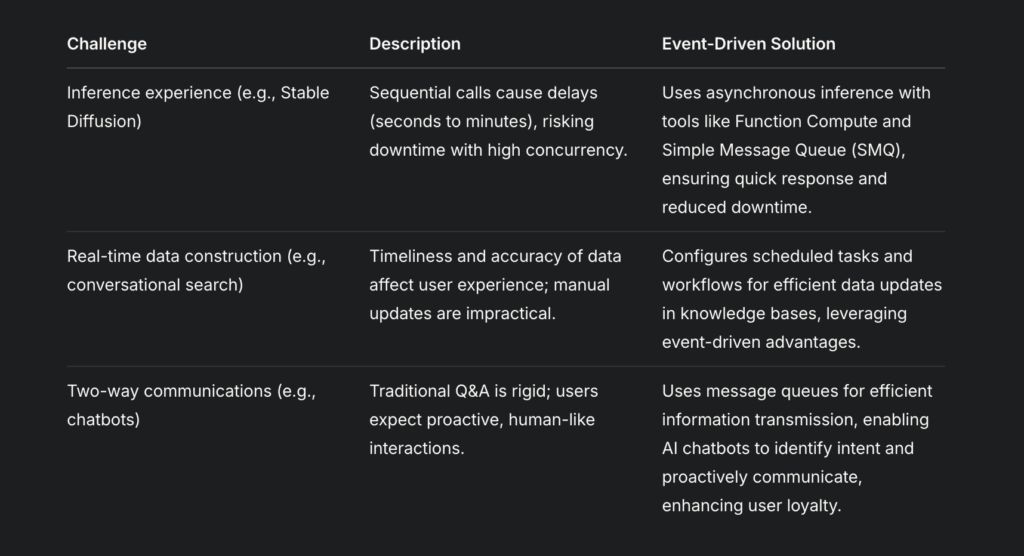
To further illustrate, consider the following table comparing challenges in AI applications and how EDA addresses them, based on insights from industry practices:

To further illustrate, consider the following table comparing challenges in AI applications and how EDA addresses them, based on insights from industry practices:This table, derived from Alibaba Cloud Community, highlights how EDA tackles specific AI challenges, reinforcing its suitability for these applications.

Conclusion and Future Outlook

EDA provides a flexible and scalable framework that is particularly well-suited for AI applications. By leveraging patterns such as asynchronous inference, real-time data updates, event-triggered actions, and component decoupling, organizations can build AI systems that are responsive, efficient, and adaptable to changing requirements. The use cases, from chatbots to predictive maintenance, demonstrate practical applications that enhance business outcomes and user experiences.

Looking forward, as AI continues to advance and integrate more deeply into various aspects of business and society, the importance of robust, event-driven architectures will only grow. Technical leaders, particularly CTOs, can position their organizations at the forefront of this evolution by adopting EDA, delivering innovative and high-impact AI solutions that meet the demands of a dynamic digital landscape.

How AI is Revolutionising Behavioural Biometrics For Authentication

Advanced technology like AI is completely changing the world of behavioural biometrics. A new and much better era of secure authentication procedures is being developed. For instance, monitoring the individual characteristic traits of a user like their writing tempo, movement of the mouse, and pressing on touchscreens makes possible AI powered behavioural biometrics and gives verification continuously and without interruption, thus making the experience better for the user and securing it more efficiently.

The History of Behavioural Biometrics

From the very beginning, every authentication system that utilises passwords and biometrics like fingerprints have been vulnerable to bypassing. On the other hand, behavioural biometrics employ dynamic interactions and actions performed by users which are nearly impossible to imitate, strengthening the security framework. Here, AI plays a critical role by examining massive amounts of user interactions in real-time by detecting small deviations that conventional systems would miss.

AI’s Role in Enhancing Behavioural Biometrics

With AI, relevant traits can be extracted from user interactions, and behavioural data may be turned into measurable metrics. User validation allows the application of intrinsic pattern recognition and the more advanced methods like neural networks and support vector machines. Continuous monitoring enables instant detection of anomalies, which aids in responding rapidly to security risks and unauthorised access.

Real-World Applications and Metrics

  1. Fraud Detection in Financial Services: A leading European insurer implemented behavioural biometrics to analyse how claimants interacted with online forms, detecting unnatural typing patterns and navigation behaviours indicative of fraud. This led to a 40% reduction in fraudulent claims within six months.
  2. Enhanced Customer Experience: An American health insurance company used behavioural biometrics for customer authentication, recognising users based on their interaction patterns with the company’s app. This approach reduced average customer service call times by 30%, significantly improving customer satisfaction.
  3. Risk Assessment Accuracy: A life insurance provider in Asia incorporated behavioural biometrics to refine risk assessment models by analysing lifestyle patterns affecting health and longevity. This led to more accurate premium calculations and personalised insurance packages.

Privacy and Needed Ethics

The application of AI in behavioural biometrics comes with notable ethical and data privacy issues. Even though these systems increase security, they need to be applied with care and responsibility, given the nature of the data. Security, user privacy, and inclusivity need to be balanced very carefully. Approaches like federated learning and edge computing provide the means for AI models to be trained on the user’s device, which greatly minimises the danger of breaches and strengthens compliance with privacy laws such as the GDPR.

Challenges and Future Outlook

Though promising, behavioural biometrics struggle with privacy and accuracy, as well as general user acceptance. Businesses in the field need to fortify protections and gain consent from users to avoid oversharing sensitive information. Usability and security have to be balanced because excessive false acceptances or rejections can undermine user trust in the system. Building trust requires addressing cultural differences along with the need for openness. Incorporating ethics focused on privacy, consent, and robust security makes the system more reliable.

With the advancement of technology, the integration of AI with behavioral biometrics will enhance authentication systems across numerous industries, providing users the ideal security and convenience.

RISC-V Chip Adoption Driven by a Strategic Policy Set to Launch by China’s 2025

In a landmark move poised to reshape its technological landscape, China is gearing up to launch its inaugural national policy championing the adoption of RISC-V chips. This strategic initiative, slated for release as early as March 2025, marks a significant step in the country’s quest to pivot away from Western-dominated semiconductor technologies and bolster its homegrown innovation amid escalating global tensions.

Insiders familiar with the development reveal that the policy has been meticulously crafted through a collaborative effort involving eight key government entities. Among them are heavyweights like the Cyberspace Administration of China, the Ministry of Industry and Information Technology, the Ministry of Science and Technology, and the China National Intellectual Property Administration. Together, these bodies aim to cement RISC-V’s role as a cornerstone of China’s burgeoning tech ecosystem, fostering an environment ripe for domestic chip development and deployment.

The mere whisper of this policy has already sent ripples through the financial markets, igniting a wave of optimism among investors. On the day of the leak, Chinese semiconductor stocks staged an impressive rally. The CSI All-Share Semiconductor Products and Equipment Index, which had been languishing earlier, reversed course to surge by as much as 2.5%. Standout performers included VeriSilicon, which hit its daily trading cap with a 10% spike, alongside ASR Microelectronics, Shanghai Anlogic Infotech, and 3Peak, whose shares soared between 8.6% and an eye-catching 15.4% in afternoon trading.

At the heart of this policy push lies RISC-V, an open-source chip architecture that’s steadily carving out a global niche as a versatile, cost-effective rival to proprietary giants like Intel’s x86 and Arm Holdings’ microprocessor designs. Unlike its high-powered counterparts, RISC-V is often deployed in less demanding applications—think smartphones, IoT devices, and even AI servers—making it a pragmatic choice for a wide swath of industries. In China, its allure is twofold: slashed development costs and, critically, its freedom from reliance on U.S.-based firms, a factor that’s taken on heightened urgency amid trade restrictions and geopolitical friction.

Until now, RISC-V’s rise in China has been organic, driven by market forces rather than official mandates. This forthcoming policy changes the game, thrusting the architecture into the spotlight as a linchpin of Beijing’s broader campaign to achieve technological self-sufficiency. The timing is no coincidence—U.S.-China relations remain strained, with American policymakers sounding alarms over China’s growing leverage in the RISC-V space. Some U.S. lawmakers have even pushed to curb American companies’ contributions to the open-source platform, fearing it could turbocharge China’s semiconductor ambitions.

China’s RISC-V ecosystem is already buzzing with activity, spearheaded by homegrown innovators like Alibaba’s XuanTie division and rising star Nuclei System Technology, both of which have rolled out commercially viable RISC-V processors. The architecture’s flexibility is proving especially attractive in the AI sector, where models like DeepSeek thrive on efficient, lower-end chips. For smaller firms chasing affordable AI solutions, RISC-V offers a tantalizing blend of performance and price—a trend that could gain serious momentum under the new policy.

Sun Haitao, a manager at China Mobile System Integration, underscored the pragmatic appeal of RISC-V in a recent statement. “Even if these chips deliver just 30% of the performance of top-tier processors from NVIDIA or Huawei,” he noted, “their cost-effectiveness becomes undeniable when you scale them across multiple units.” This scalability could prove transformative for industries looking to maximize output without breaking the bank.

As China prepares to roll out this groundbreaking policy, the global tech community is watching closely. For Beijing, it’s a calculated gambit to secure its place at the forefront of the semiconductor race—one that could redefine the balance of power in a world increasingly divided by technology.

Wallets of darknet marketplace Nemesis hit by US sanctions

The US Treasury Department’s Office of Foreign Assets Control (OFAC) has added 44 Bitcoin and five Monero addresses associated with the closed darknet marketplace Nemesis Market to the SDN.

The press release says they were controlled by Iranian citizen Behrouz Parsarad, who was allegedly the platform’s administrator.

On March 20, 2024, BKA seized Nemesis Market infrastructure in Germany and Lithuania, disrupting its operations. In the process, police confiscated digital assets worth €94,000.

The investigation began in October 2022.

The platform, created in 2021, sold drugs, stolen data and credit cards, as well as cybercriminal services, including ransomware, phishing, and DDoS.

Before the shutdown, Nemesis had an active audience of 30,000 users who carried out ~$30 million in drug transactions.

Parsarad received millions of dollars in commissions from the transactions and facilitated the laundering of digital assets, according to OFAC.

The administrator remains at large. According to the agency, Parsarad may have “discussed the creation of a new darknet market” with former suppliers.

Recall that in April 2022, German police confiscated the servers of the darknet marketplace Hydra and seized 543 BTC, and the US Treasury imposed sanctions on the platform.

That same month, an American court indicted Russian Dmitry Pavlov in absentia for administering Hydra, providing it with hosting services, conspiring to launder money, and distributing drugs. At the same time, the Meshchansky District Court of Moscow arrested Pavlov on another charge.

In December 2024, the Moscow Regional Court sentenced Hydra founder Stanislav Moiseev to life imprisonment and a fine of 4 million rubles.

The Role of Digital Twins in Building the Next Generation of Data Centers

contributed by Aleksandr Karavanin, Production Engineer at Meta

With increasing numbers of new-age businesses relying on online services, data centers have become the backbone of global operations. However, it has become increasingly difficult to maintain them, with complexities such as power efficiency, downtime of systems, and real-time monitoring. In an effort to address these problems, Digital Twin technology has become a game-saver, which allows organizations to create virtual representations of their data centers to achieve maximum performance, predict failures, and improve operational efficiency.

Understanding Digital Twins in Data Centers

A Digital Twin  is a virtual representation of a physical system, continuously updated with real-time data to reflect the actual conditions of the infrastructure. For data centers, digital twins merge Internet of Things (IoT) sensors, Artificial Intelligence (AI), and machine learning algorithms to monitor and replicate real world conditions in authentic-to-life depiction.

Data center management has moved from manual monitoring and reactive maintenance to AI-driven automation. The transition enables IT teams to make data-driven decisions to achieve maximum resource utilization, zero downtime, and improved performance.

One of the greatest advantages of digital twins is that they provide real-time insight into data center operations. By constantly consuming data from power usage, cooling systems, and hardware performance, the virtual replicas provide a comprehensive view of the health of the facility. Virtual simulations allow organizations to experiment with different configurations, optimizing energy efficiency and reducing operational risks.

On the other hand, one of the key benefits of digital twins is their ability to enable proactive decision-making through real-time monitoring. By continuously analyzing incoming data from critical systems, digital twins offer IT teams unparalleled visibility into the health and efficiency of the data center.

Benefits of Real-Time Monitoring:

Real-time monitoring is a crucial aspect of data center management, ensuring efficiency and preventing interruptions. Digital twins provide a real-time flow of information from various infrastructure components, allowing IT personnel to detect inefficiencies, predict resource needs, and solve potential issues ahead of time. Leveraging this real-time visibility, organizations can enhance performance and reduce operational risks.

  • Faster Issue Detection and Troubleshooting

Digital twins enable IT personnel to identify and fix system failures before they are an issue. By constantly monitoring cooling system data, power usage, and server performance, they trigger instantaneous alerts when issues are detected, allowing for immediate response.

  • Increased Capacity Planning

By analyzing data trends, organizations are able to predict when additional resources will be required, scaling seamlessly. It helps businesses scale their data center operations in a cost-effective way, preventing bottlenecks and optimizing resource utilization.

These benefits are not just theoretical, leading tech companies are already leveraging digital twins to transform their data center operations. One standout example is Thésée DataCenter, which has successfully implemented digital twin models to optimize its cooling systems.

Thésée DataCenter opened the first fully interactive digital twin in a colocation environment in 2022. The digital twin provides customers with a 3D view of their IT equipment, power usage, and operating conditions, with real-time visibility on performance and service levels. By enabling precise knowledge of infrastructure capacity and risk-free planning of future installations, Thésée DataCenter has simplified capacity planning and anticipated necessary changes to cooling infrastructure, achieving aggressive energy performance objectives.

Apart from real-time monitoring and capacity planning, digital twins also play a critical part in predictive maintenance and proactive incident management. Rather than addressing issues after they happen, digital twin technology allows organizations to shift from a reactive to a predictive maintenance approach, reducing the likelihood of surprise failures.

Predictive Maintenance and Proactive Incident Response

Traditional data center maintenance often follows a reactive approach, addressing issues only after they cause disruptions. Digital twins, however, enable a shift toward predictive maintenance, where AI-driven analytics detect potential failures before they occur.

By analyzing historical and real-time data, digital twins identify patterns that indicate impending hardware failures or cooling inefficiencies. This predictive capability reduces the risk of sudden outages, minimizing downtime and repair costs.

Beyond predicting failures, digital twins also enhance proactive incident response, it is a crucial advantage of digital twin technology in data center management.Through AI-based automation and real-time analytics, digital twins allow organizations to detect possible risks early and respond instantly, minimizing disruptions and ensuring continuity of operations.

Automated Risk Detection

AI constantly monitors hardware performance, power fluctuations, and security threats, analyzing massive amounts of information in real-time. Preemptive monitoring enables IT personnel to identify anomalies that can predict impending failures, such as overheated servers, power supply irregularities, or attempts at unauthorized entry. By detecting these threats before they occur, organizations prevent cascading failures that can trigger downtime or security incidents.

For example, if a digital twin detects unusual power consumption in a server rack, it can warn of a potential power supply issue before it results in an outage. Similarly, in security scenarios, AI-driven monitoring can flag suspicious access patterns, enabling IT personnel to take action before a security breach occurs.

However, detecting anomalies is only the first step, timely alerts and swift response mechanisms are equally critical to preventing disruptions. This is where AI-driven alerts come into play, ensuring that IT teams receive real-time notifications and can take immediate corrective action.

AI-Driven Alerts and Immediate Response

Digital twins not only detect issues but also generate automated alerts based on predefined thresholds and AI-driven insights. These alerts provide IT teams with real-time notifications about potential risks, enabling them to take immediate corrective action.

  • Real-Time Notifications: Digital twins send instant alerts through dashboards, emails, or integrated management systems, ensuring IT personnel are informed the moment an issue arises.
  • Automated Mitigation Actions: In some cases, AI can trigger automated responses, such as redistributing workloads to prevent overheating, adjusting cooling parameters, or isolating compromised systems to mitigate security threats.
  • Incident Prioritization: By analyzing the severity of detected issues, digital twins help IT teams prioritize responses, ensuring critical problems are addressed first while routine maintenance tasks are scheduled accordingly.

This proactive approach reduces downtime, optimizes resource utilization, and enhances the overall resilience of data center operations. But how effective is this in practice?

A premier cloud services company leveraged digital twin technology to improve data center reliability and reduce operational costs, resolving for unexpected server failures that caused costly downtime and increased maintenance costs. By integrating digital twins in its infrastructure, the company created virtual replicas of its physical servers, cooling systems, and power distribution networks that allowed real-time monitoring of the critical parameters such as CPU temperature, workload balancing, power fluctuations, airflow efficiency, and security threats. 

With AI-powered predictive analytics, the digital twin picked up early warning signs of the potential failures before they had turned into critical problems. This deployment caused a reduction of 30% in downtime, with AI detecting anomalies in server performance, triggering real-time alerts and enabling IT teams to replace or repair components before disruption. Automated mitigation strategies, such as workload redistribution, also ensured continued service continuity. 

Predictive maintenance also lowered maintenance costs by 20%, with fewer emergency repairs, optimized scheduling of routine maintenance, and improved efficiency of cooling systems to lower energy consumption. The enhanced monitoring and proactive incident response also raised service reliability, allowing IT teams to divert their energies away from reactive problem-solving and towards strategic innovation, and ultimately, improving uptime and customer satisfaction. 

In this change, the cloud services provider demonstrated how AI-driven predictive analytics and digital twins can significantly enhance infrastructure resilience and cost efficiency.

Future of Digital Twins in Data Centers

The previous case study highlights the huge benefits of AI-driven digital twins in enhancing data center operations. As we can see, the use of digital twin technology has led to stunning decreases in downtime, maintenance costs, and overall improvements in service reliability. These advantages highlight the huge potential digital twins hold to transform data centers today. Looking ahead, the future of digital twins in data centers seems even more promising.

As AI and machine learning continue to advance, the capabilities of digital twins will expand, offering even greater automation and efficiency in data center operations. The rapid integration of edge computing and high speed mobile networks will further enhance real-time data processing, enabling faster decision-making and improved latency management.

However, the widespread adoption of digital twins is not without challenges. Data security concerns, high implementation costs, and system complexity remain potential obstacles. Consequently, organizations must ensure robust cybersecurity measures and assess the return on investment before deploying digital twin solutions at scale.

Conclusion

In conclusion, digital twins are transforming data center management by enabling real-time simulation, predictive maintenance, and proactive incident response. As organizations strive for smarter, self-optimizing and self-healing data centers, digital twin technology will play a crucial role in ensuring efficiency, reliability, and sustainability.

Looking ahead, businesses that embrace digital twins will gain a competitive advantage, reducing operational risks and improving resource management. Finally, as technology evolves, the future of data centers will be defined by intelligent automation, setting the stage for a new era of digital infrastructure.

Opinion: AI Will Never Gain Consciousness

Artificial intelligence will never become a conscious being due to the lack of aspirations that are inherent in humans and other biological species. This statement was made by Sandeep Naiwal, co-founder of Polygon and the AI ​​company Sentient, in a conversation with Сointelegraph.

The expert does not believe that the end of the world is possible due to artificial intelligence gaining consciousness and seizing power over humanity.

Nailwal was critical of the theory according to which intelligence arises accidentally as a result of complex chemical interactions or processes. Although they can lead to the emergence of complex cells, there is no talk of the emergence of consciousness, the entrepreneur noted.

The co-founder of Polygon also expressed concerns about the risks of surveillance of people and the restriction of freedoms by centralized institutions with the help of artificial intelligence. Therefore, AI should be transparent and democratic, he believes.

[…] Ultimately, global AI, which can create a world without borders, must be controlled by every person,” Nailwal emphasized.

He added that everyone should have a personal artificial intelligence that is loyal and protects against the neural networks of influential corporations.

Recall that in January, Simon Kim, CEO of the crypto venture fund Hashed, expressed confidence that the future of artificial intelligence depends on a radical shift: opening the “black box” of centralized models and creating a decentralized, transparent ecosystem on the blockchain.